XTT: What Can a Bow Tell Us About a Shot?
A bow-mounted sensor can measure movement remarkably well. The harder question is what that movement can actually tell us about the shot - and where measurement ends and interpretation begins.

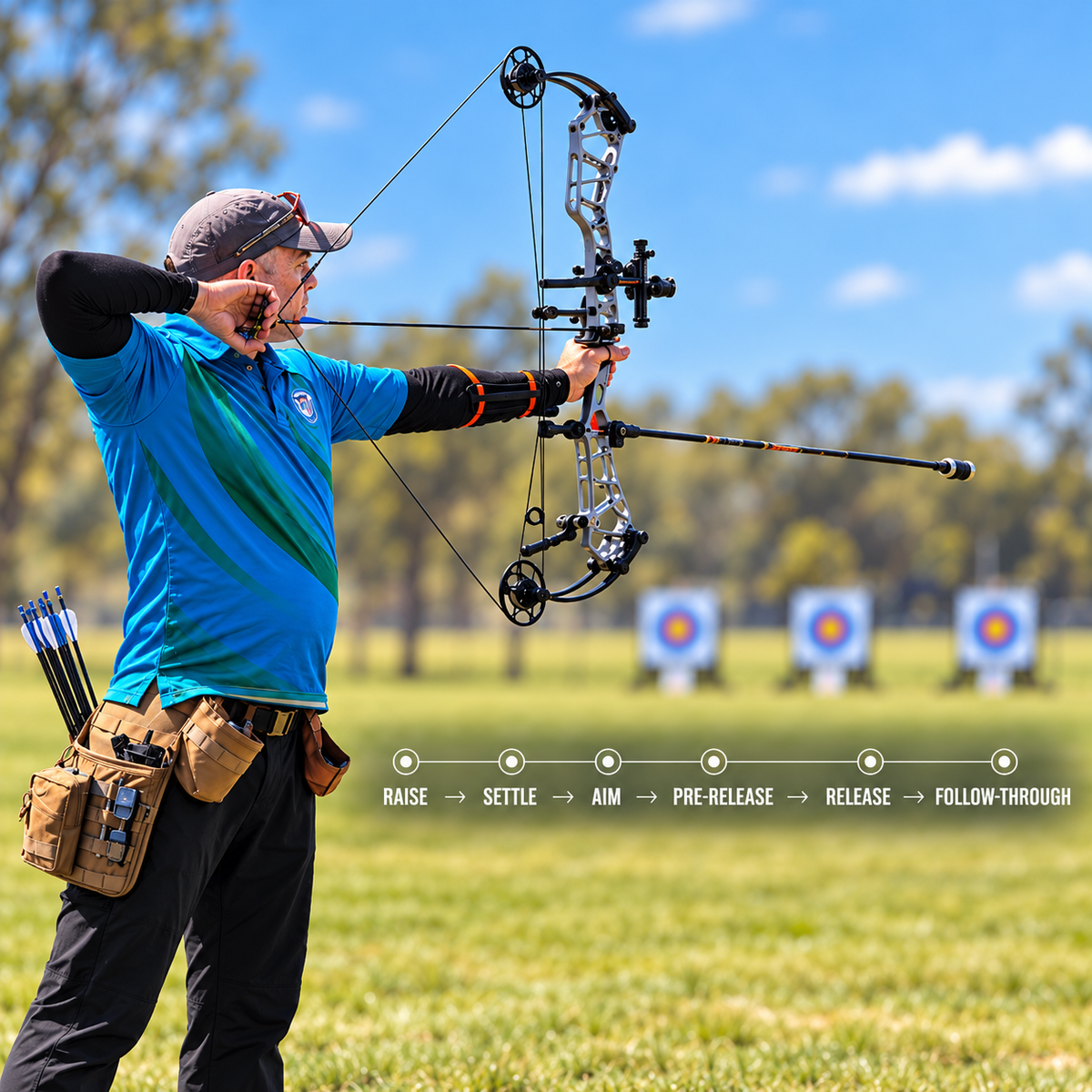
Before trying to score or coach a shot, the first question is much more basic: what can a small sensor attached to the bow actually measure - and what are we only inferring from those measurements?
In the first XTT article I wrote about why I started the project: I am a competitive recreational archer with limited training time, and I wanted a way to learn more from the practice time I can actually fit into normal life.
That immediately leads to the next question: What can a bow actually tell us about a shot?
It sounds simple, but it is probably one of the most important questions in the whole project.
A sensor mounted to the bow can measure movement extremely well.
It cannot see my stance.
It cannot see where my elbow is.
It cannot know what I am thinking.
It cannot see the target through my scope or sight.
And it certainly cannot look at one strange movement and confidently announce, "You plucked that shot."
What it can do is measure how the bow moved, very precisely, through the few seconds surrounding the release.
The challenge is turning that physical evidence into something useful without pretending the sensor knows more than it really does.
A shot is not a single event
When we talk about "a shot", it is tempting to think of the instant the arrow leaves the bow.
But from a training perspective, the shot is a sequence of events.
The exact terminology will vary between archers, coaches and bow styles, but for XTT I find it useful to think of it roughly like this:
Raise → Settle → Aim → Pre-release → Release → Follow-through
During the raise, the bow is moving relatively quickly as it comes onto the target.
During settling, that movement reduces as the archer establishes the shooting position.
During the aim, the bow is never completely still. There is movement, drift and fine vibration.
The pre-release period is particularly interesting because this is where the final part of execution happens. Changes here may be subtle, but they can be very different between a well-executed shot and one where something starts to break down (in my case, when the monkey-circus in my head gets the better of me).
Then there is the release itself.
That creates a very distinctive mechanical event in the bow.
And after that comes follow-through: how the bow reacts, rotates, vibrates and settles after the string has been released.
From the sensor's point of view, these are not abstract coaching terms. They are different patterns of movement occurring in a particular order.
That is something electronics can measure.
What the sensor actually measures
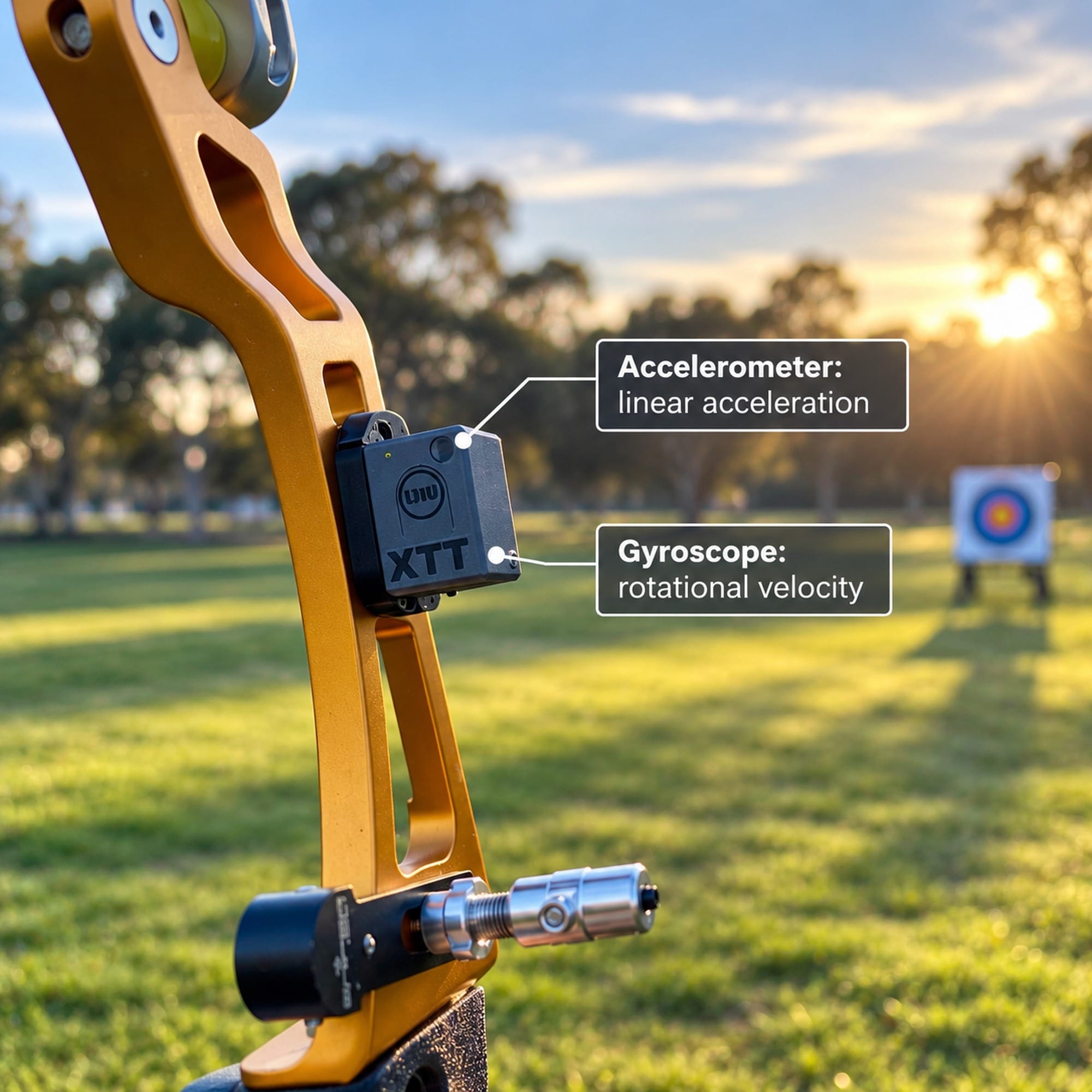
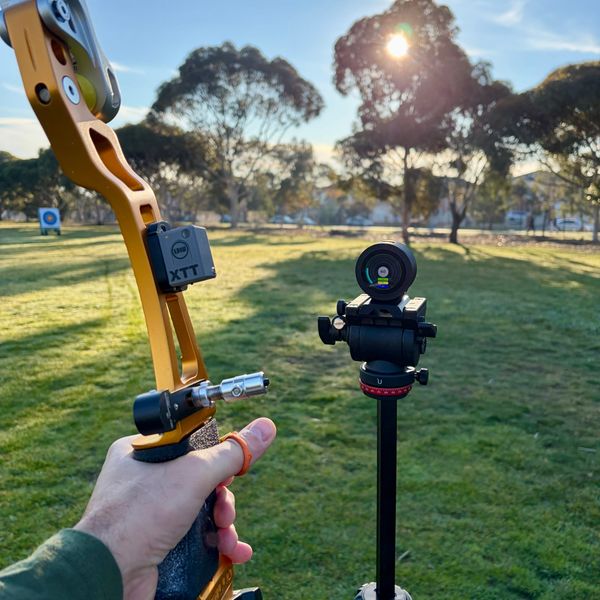
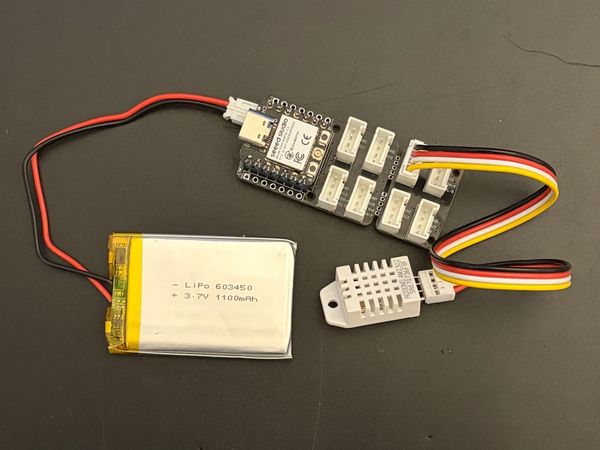
At the heart of the XTT-Sensor is an IMU - an Inertial Measurement Unit.
The important parts for this discussion are the accelerometer and gyroscope.
The accelerometer measures linear acceleration.
In plain language, it tells us how the sensor is being accelerated along its axes (x, y and z). It also sees gravity, which is useful for understanding orientation when the bow is relatively stationary.
The gyroscope measures rotational velocity.
It tells us how quickly the bow is rotating around its axes.
Put the two together, sample them repeatedly, and we get a time history of how the bow moved.
That is the raw evidence.
It is worth being precise about this because it is easy to jump too quickly from a measured signal to a coaching conclusion.
The sensor does not measure "bad release".
It measures acceleration and rotation around the release.
It does not measure "fatigue".
It may measure increasing tremor, increasing drift or longer settling over a session - patterns that could be consistent with fatigue.
It does not measure "collapse".
It measures movement before and after the release that may form part of the evidence for a collapse.
That distinction has become fundamental to how I think about XTT.
Measurement is not interpretation
One of the questions I received after the first XTT article was about how it compares with systems such as Mantis X8 and Steady Aim.
Both already use sensors on the bow to measure movement.
Mantis, for example, shows the movement of the bow through different phases of the shot, provides stability and timing information, and includes diagnostic feedback. Steady Aim provides metrics such as steadiness, drift, cant, hold time and vibration analysis.
So the interesting question is not:
Can motion sensors measure an archery shot?
They clearly can. A more useful question is:
How do we translate those measurements into feedback that is easy to use?
The feedback I received on Social Media comments, was that a solution like XTT should be very easy to use in practice. I think that is an important observation, although it is also a very subjective one.
There is an unavoidable tension here.
More data gives you more ways to investigate a shot.
But more data also gives you more things to understand.
A detailed trace can be extremely useful to a coach, engineer or archer who enjoys analysing data. To somebody who has just shot six arrows and wants to know what to work on in the next six, it can also become yet another problem to solve.
This is one of the areas where I want XTT to take a particular approach.
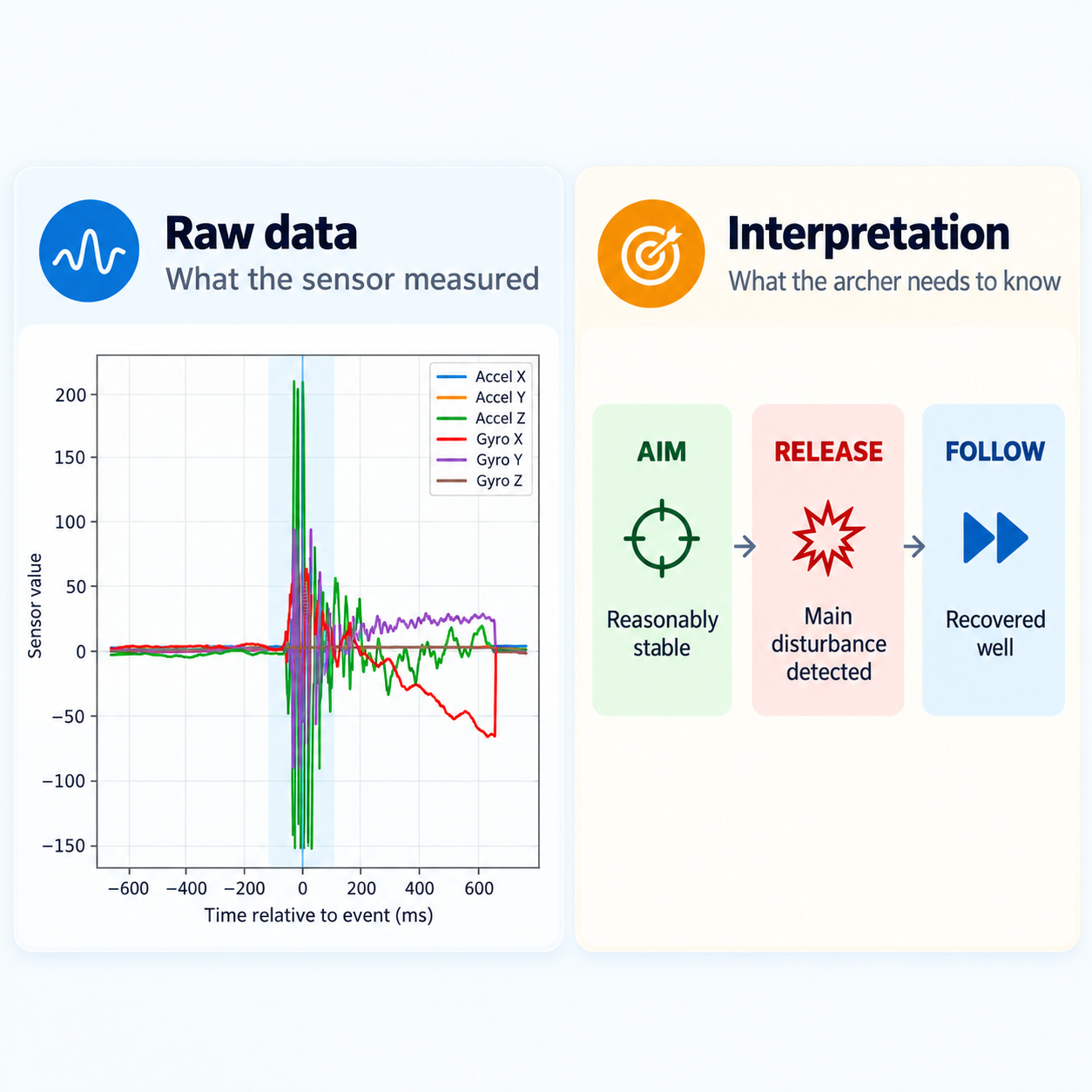
The raw measurements should remain available. But the immediate feedback should try to answer something simpler:
What changed, and what should I pay attention to during my next shot?
That is why the current XTT architecture separates the system into layers.
At the bottom is the measured information - the closest thing XTT has to objective truth.
Above that sit derived metrics.
And above those sit human-facing interpretations such as AIM, RELEASE and FOLLOW.
Those top-level indicators are not additional sensor measurements.
They are interpretations of several measurements taken during different parts of the shot process.
That is a very important distinction.
Why timing matters so much
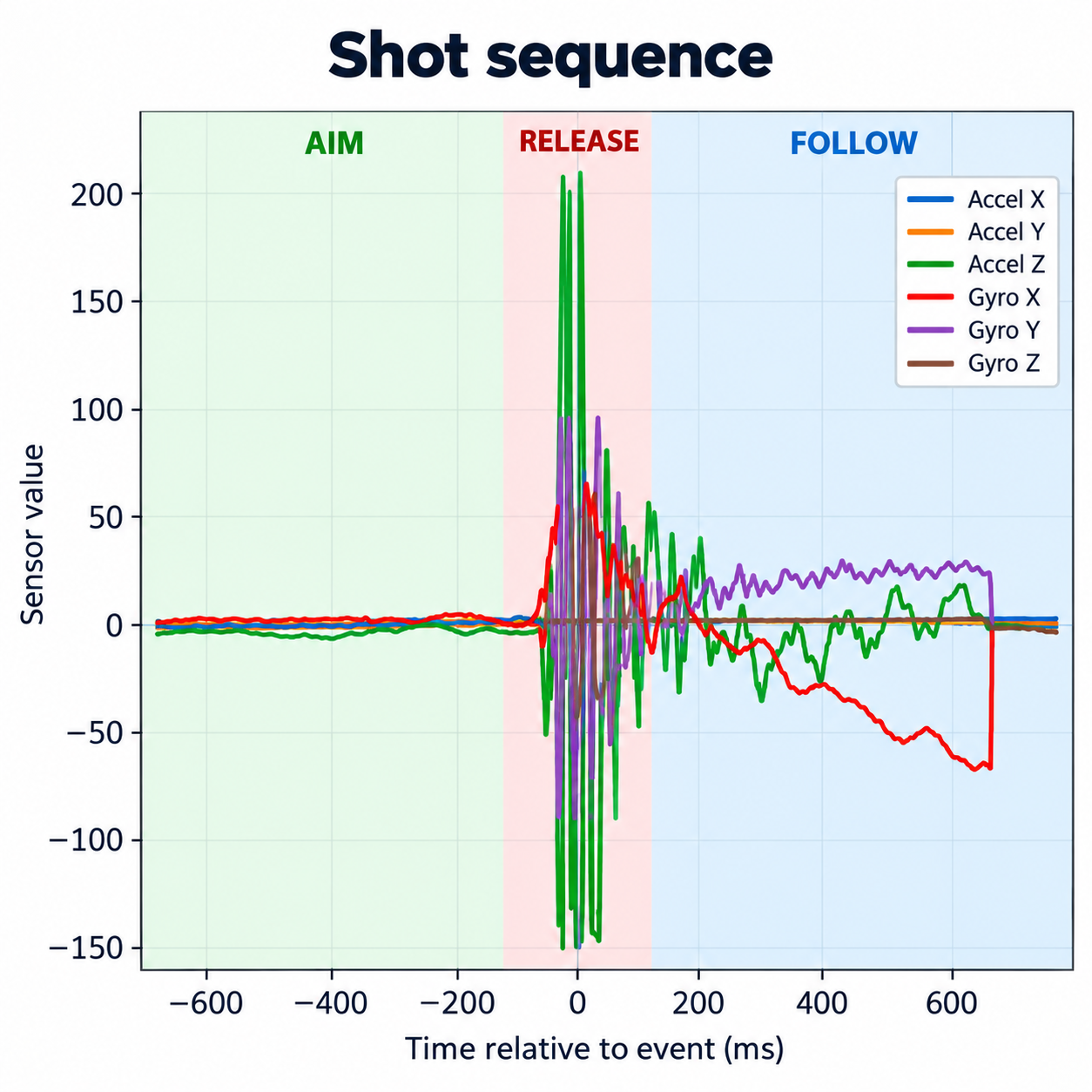
Imagine I tell you that the bow experienced a sudden increase in rotational movement.
Is that good or bad?
Without knowing when it happened, the number does not tell us much. A rotational movement while raising the bow may be completely irrelevant. The same movement during the final fraction of a second before release could be much more interesting.
A large movement immediately after the release may simply be the normal mechanical reaction of the bow.
So before XTT can interpret a shot, it first needs to align the movement in time.
The release becomes the reference point.
Once the release is identified, we can ask questions such as:
- What was happening before it?
- How stable was the bow while aiming?
- Was movement increasing as the release approached?
- What changed at the release?
- How did the bow behave immediately afterwards?
- How quickly did the system settle?
This is why shot detection is not merely a convenient way of counting arrows.
It is the anchor that lets us compare one part of the shot with another.
If that anchor is wrong, the analysis windows are wrong.
And if the windows are wrong, even perfectly accurate sensor values can produce a misleading interpretation.
One of the engineering principles that emerged quite early in XTT was: Data quality first.
Or, in one of my less formal project notes: RAM is cheap. Bad data is expensive.
Detection is physics. Evaluation is personal.
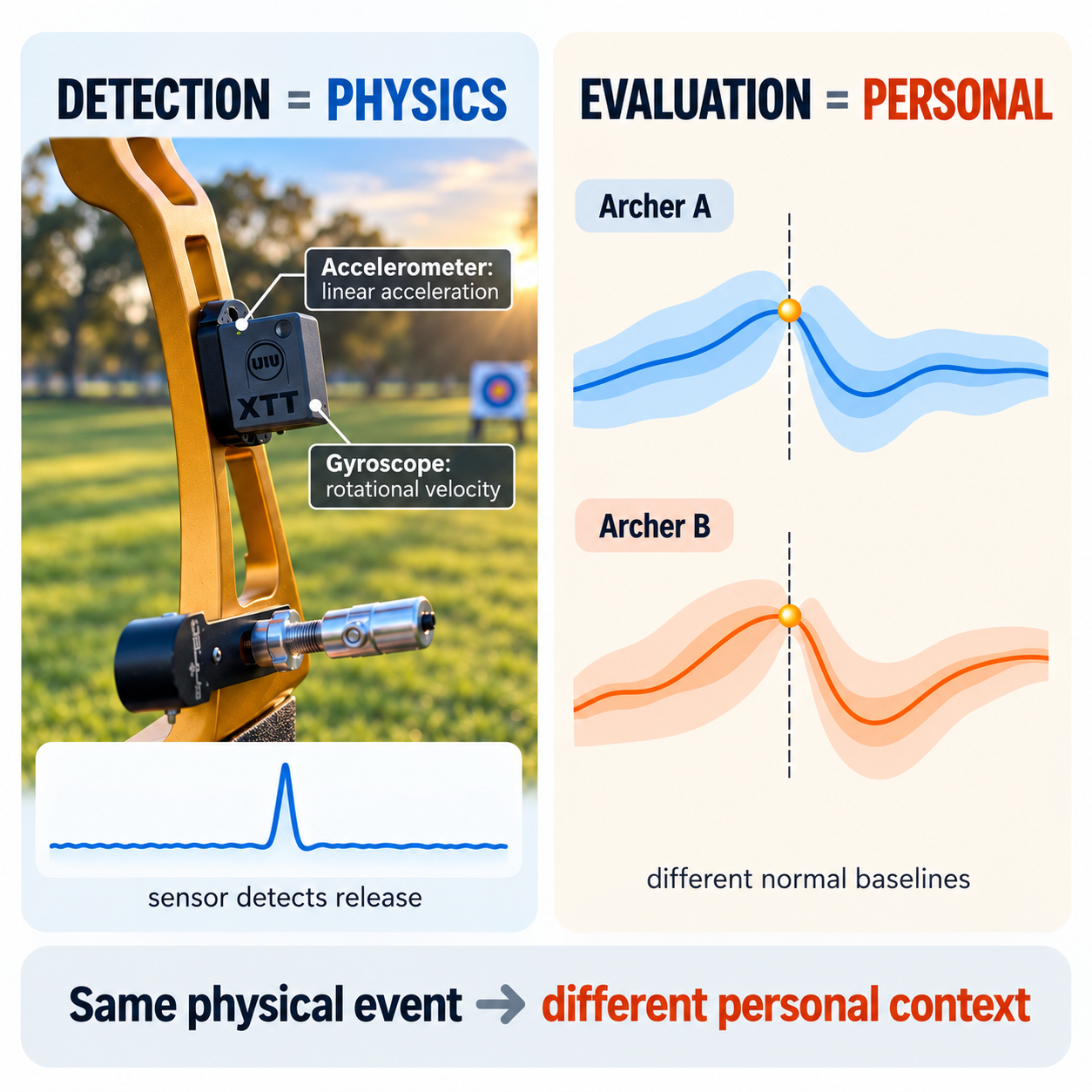
There is a phrase I have started using to describe an important XTT principle:
Detection is physics. Evaluation is personal.
The release event is a physical event.
The string is released, energy is transferred, the arrow accelerates and the bow reacts.
The sensor should be able to identify that event from the physical motion.
That part should not depend on whether I am a beginner, an international archer, shooting recurve or shooting compound.
The evaluation of the surrounding movement is different.
How much movement is "good"?
How much drift is acceptable?
How quickly should I settle?
How much release disturbance is normal?
There is no single number that makes sense for everybody. Even for the same archer, those answers change with technique, equipment, fitness and experience.
That is why XTT is being developed around the idea of an evolving personal baseline rather than one universal definition of a perfect shot.
The sensor tells us what happened physically.
The interpretation asks how that compares with your own current capability.
That is where measurement starts becoming training information.
What can XTT reasonably infer?
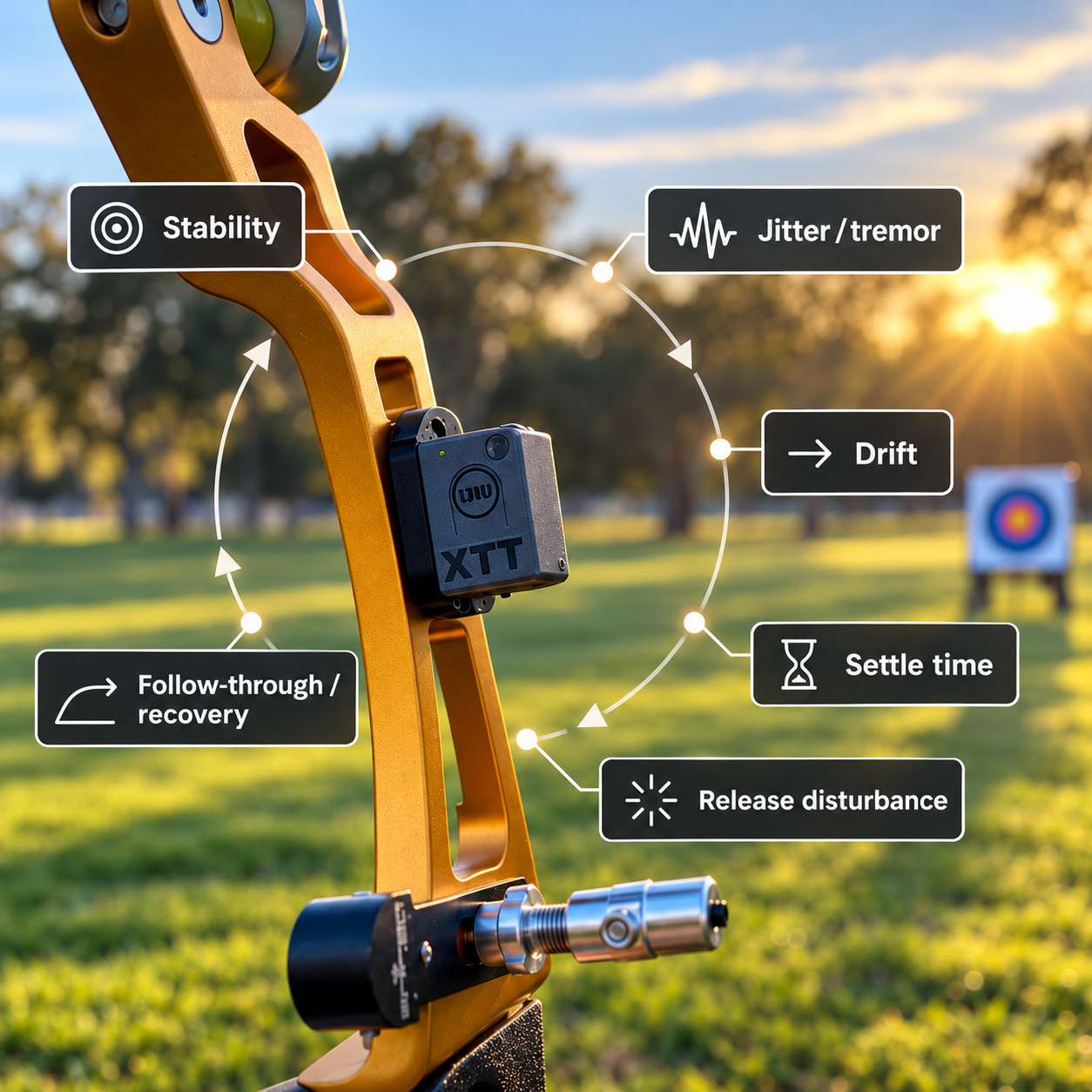
From bow movement, XTT can reasonably calculate or derive things such as:
- overall aiming stability;
- fine jitter or tremor;
- directional drift;
- how long it takes the bow to settle;
- movement immediately before the release;
- acceleration and rotational disturbance around release;
- stability and recovery after release;
- changes in those patterns over time.
Those are all closely connected to things archers and coaches care about.
But the next step - turning a pattern into a diagnosis - needs more caution.
If the bow shows unusual movement immediately before release, that is evidence.
It might be consistent with anticipation.
It might be connected to the release hand.
It might be bow-arm movement.
It might be something completely different that happened elsewhere in the archer's technique.
A sensor mounted on the bow cannot know that by itself. This is why I do not want XTT to become a machine that confidently invents explanations for everything it sees.
Sometimes the most useful message may simply be:
Your release movement was significantly different from your normal pattern.
That gives the archer, or the coach, something specific to investigate.
The things the bow cannot tell us
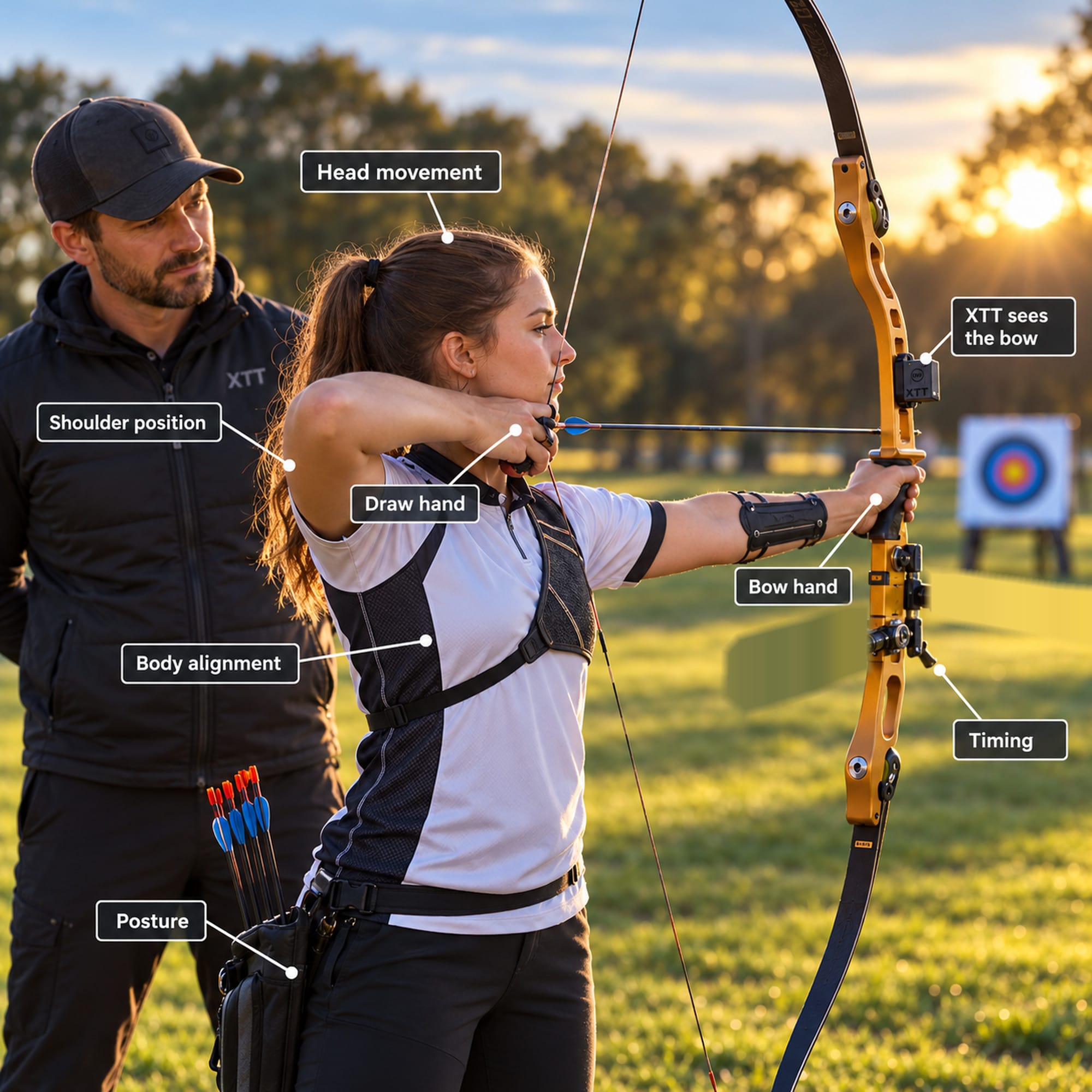
This limitation is also why I keep saying that XTT is not intended to replace a coach.
A coach sees the whole archer.
They can see body alignment, shoulder position, head movement, draw hand, bow hand, posture and timing.
They may also know what the archer has been working on, how they are feeling, and what changed in the previous end.
XTT only sees the bow. It cannot directly see:
- body alignment;
- shoulder position;
- finger or release-aid technique;
- the target image the archer sees;
- mental state or confidence;
- wind conditions unless that information comes from somewhere else;
- whether an equipment change was deliberate;
- the coaching context surrounding the shot.
That sounds like a weakness, but I think it is actually a useful boundary.
The coach and XTT observe different things.
A coach might say:
"You looked like you collapsed through that one."
XTT may add:
"There was also an unusually large change in bow movement immediately before release and a different follow-through pattern."
Neither observation needs to replace the other.
Together they may tell us more.
Evidence, not a verdict
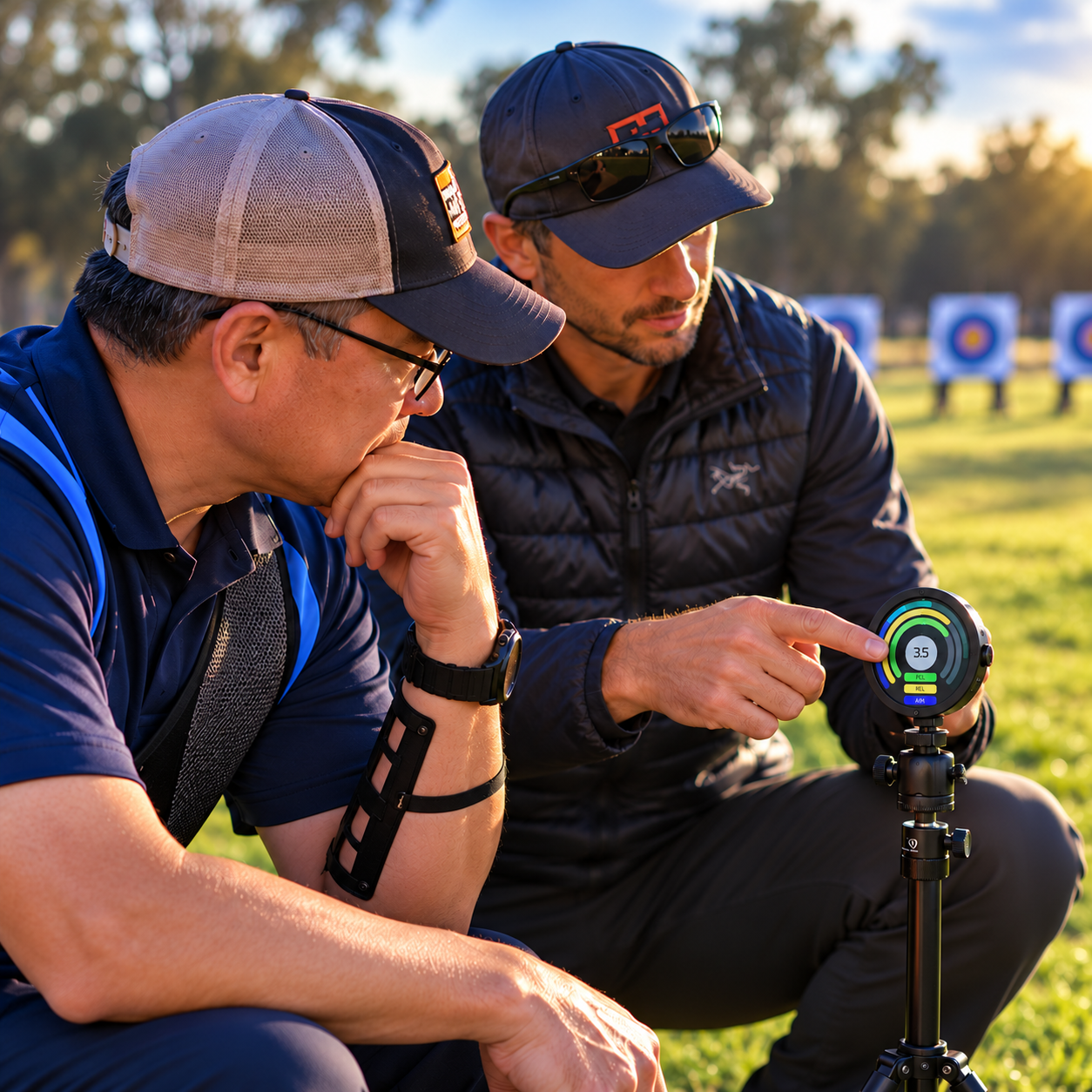
This is probably the most important idea in this article.
Raw sensor data is evidence, not a complete diagnosis.
The IMU gives XTT a very precise view of one part of the shooting system: the bow.
The engineering challenge is to preserve that measured truth, identify the important moments in time, derive useful metrics from them, and then present those metrics without pretending we have measured things we have not.
That is also why I want the deeper data to remain accessible.
An archer who simply wants useful feedback should not need to study graphs.
A coach may want to look deeper.
Someone interested in sports science may want the raw data.
And in future, XTT-Cloud may be able to combine longer-term history with other information and provide much richer analysis.
But all of those later layers depend on getting the first layer right: What did the bow actually do?
In the next article I want to go one step deeper into the architecture and explain why XTT ended up as two separate devices - the bow-mounted XTT-Sensor and the archer-facing XTT-Coach - rather than simply sending everything to a phone.